

adversiment
Nearly 80% of Americans use artificial intelligence every week. They might not even know it. It’s in virtual assistants, streaming services, and smart thermostats.
This article shows how AI changes our daily lives. It talks about smart home devices, virtual assistants, and automated offices. It also covers AI in healthcare and finance.
We’ll explain key AI concepts like neural networks and natural language processing. You’ll learn how these systems work and get better over time. This is to help you understand the benefits and risks of AI.
The article is divided into eleven sections. It covers everything from AI basics to its future. You’ll learn how to make smart choices about using AI tools.
Introduction to Artificial Intelligence
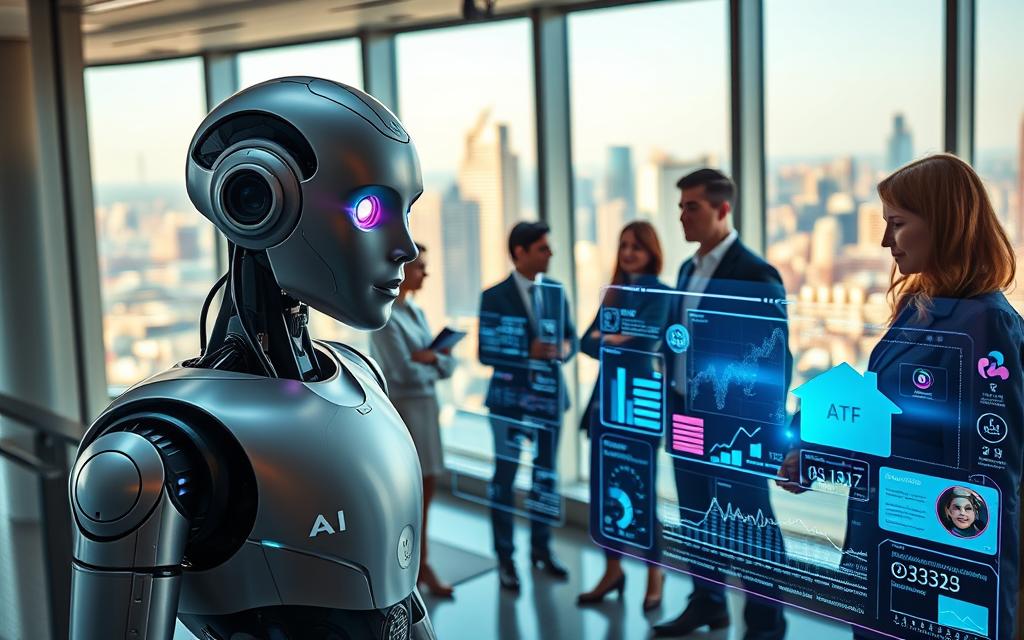
Artificial intelligence changes how we use devices, services, and data every day. This introduction covers the basics, its history, and why it’s important today. It also shows how AI is used in our homes, workplaces, health, learning, travel, and finances.
What Is Artificial Intelligence?
Artificial intelligence is a part of computer science that makes systems think like humans. These systems can see, reason, learn, and make decisions. Many things we use today, like smart assistants, rely on AI to get better over time.
Deep learning uses complex neural networks to understand images, sounds, and text. It helps machines talk like us and understand our language. Computer vision lets machines see and understand images and videos. Robotics combines sensing, planning, and action to make machines work in the real world.
Brief History of AI Development
The idea of AI started in the 1950s with Alan Turing’s question about machine intelligence. The 1956 Dartmouth workshop named the field and started research at places like MIT and Stanford. Early work focused on symbolic AI and expert systems that followed human rules.
Research slowed down in the 1970s and 1980s, known as AI winters. But, the 1990s saw a comeback with new statistical methods and more computing power. The 2010s brought big advances in deep learning, like AlexNet for vision and better language models. Leaders like Geoffrey Hinton, Yann LeCun, and Andrew Ng pushed progress at places like Google DeepMind and OpenAI.
Today, we have faster computers, more data, and better algorithms. This has made AI useful for everyday tasks. AI has made our lives more productive and convenient in many ways.
| Era | Key Developments | Notable Contributors |
|---|---|---|
| 1950s–1960s | Turing test, Dartmouth workshop, symbolic AI beginnings | Alan Turing, Marvin Minsky |
| 1970s–1980s | Expert systems, AI winters, rule-based approaches | Edward Feigenbaum, John McCarthy |
| 1990s–2000s | Statistical methods, growth of machine learning, larger datasets | Tom Mitchell, Andrew Ng |
| 2010s | Deep learning breakthroughs, AlexNet, improved computer vision | Geoffrey Hinton, Yann LeCun |
| 2020s | Transformers, large language models, advanced natural language processing | OpenAI teams, Google DeepMind researchers |
AI in Everyday Life
AI is now part of our daily lives, not just in movies. It helps us save time and makes our homes safer. It’s found in kitchens, living rooms, and even in our pockets.
Smart Home Devices Enhancing Convenience
Smart home devices like Nest thermostats learn our habits and adjust the temperature. They save energy. Smart lights change color based on our activities, making our homes more comfortable.
Security cameras from Ring and Arlo can tell the difference between people and pets. They send alerts only when needed. These devices work together through Apple HomeKit, Google Home, and Amazon Alexa.
This makes our homes safer, saves money, and helps older adults or those with disabilities live more independently.
AI in Personal Assistants: Siri, Alexa, and Google Assistant
Virtual assistants like Siri, Alexa, and Google Assistant can set reminders and control devices. They understand our conversations better thanks to machine learning. This makes them feel more like friends.
Apple focuses on keeping Siri’s data local for privacy. Google and Amazon use the cloud for more features and updates. It’s up to us to decide what’s more important: convenience or privacy.
AI assistants save us time and make our lives easier. They help with calendars, shopping, navigation, and more. Now, we can focus on what’s important without wasting time on small tasks.
Artificial Intelligence in the Workplace
AI is changing how teams work and how companies handle tasks. In today’s AI workplace, tools that use automation and machine learning cut down errors and speed up work. This lets staff focus on strategy and creativity while systems handle the routine tasks.
Streamlining Tasks with Automation
Robotic process automation (RPA) does tasks like data entry and invoice processing with perfect accuracy. Tools like UiPath and Automation Anywhere run these tasks over and over, helping across different departments.
When RPA works with machine learning, it gets even better. Systems learn from mistakes and get smarter over time. This means less human work and lower costs.
Look at how AI helps in real workplaces. HR uses AI to sort through resumes. Marketing uses AI to suggest content and test ideas. Customer service uses chatbots to quickly answer simple questions, making everyone more productive.
AI Tools for Project Management
Project management tools like Asana, Trello, and Monday.com now use AI. They predict timelines and suggest how to use resources. This is based on past data to avoid delays.
Natural language processing and deep learning analyze notes and meetings. They create updates, action items, and warn of risks. Otter.ai and Microsoft Teams help teams remember decisions and keep projects moving.
AI also helps with scheduling. It suggests priorities based on what’s been done before. It finds bottlenecks and suggests where to move resources. This means teams can do more without needing more people.
Implementation Considerations
For AI to work, it needs to fit with old systems, training for staff, and clear benefits. It’s important to help employees grow into new roles, not just replace them.
Companies should watch important metrics like how fast work gets done, how many mistakes there are, and how much each employee does. Talking openly about job changes builds trust. With careful planning, AI, automation, and human skills can make a workplace stronger and more efficient.
AI in Healthcare
AI is changing how doctors find and treat diseases. It’s used in hospitals and clinics to spot small issues and cut down on routine tasks. This technology brings data-driven insights to patient care.
Improving Diagnostic Accuracy with AI
Computer vision and deep learning look at medical images in detail. In radiology, they spot lung nodules and fractures. In dermatology, they find suspicious skin lesions. In pathology, they scan digital slides for cancer signs.
Google Health and IBM Watson Health have shown AI’s value in healthcare. Now, the FDA has cleared several tools for real-time use. These tools help doctors find diseases faster, miss fewer cases, and work more efficiently.
AI doesn’t replace doctors. It helps them by showing possible findings and how sure they are. This lets doctors focus on the tough cases.
Personalized Treatment Plans through AI
AI makes treatment plans by mixing EHR data, genomics, and medication history. In oncology, it matches patients with the right therapies. For chronic diseases, it predicts when symptoms will get worse and suggests treatment plans.
AI can predict how well a drug will work and possible side effects. This helps doctors choose the right tests and the right dose. But, these models need to be tested and approved before they’re used all the time.
Doctors still make the final decisions. AI is most helpful when doctors use it along with their own judgment and talk with patients.
Privacy, Security, and Explainability
Health data needs strong protection. HIPAA rules, secure access, and ways to hide data help keep it safe. Vendors and health systems must show how they handle data to meet rules.
Explainable AI helps doctors trust its advice by showing how it made that suggestion. This makes it safer and helps doctors talk better with patients.
- Benefits: earlier detection, workload reduction, tailored care.
- Risks managed by: HIPAA compliance, secure storage, model explainability.
- Ongoing needs: clinical validation, clinician oversight, robust data governance.
The Role of AI in Education
AI is changing how we learn and teach in schools. It helps tailor lessons, spot learning gaps, and support all kinds of students. This mix of tech and teaching makes learning better and more accessible.
Adaptive Learning Technologies
Adaptive learning platforms adjust lessons based on how well students do. Khan Academy and Coursera change content and pace to fit each student. This makes learning stick better.
These systems help students who struggle by offering extra help. They let schools give more personalized learning without needing more teachers. They also track how students are doing and help teachers improve lessons.
AI-Powered Student Support Systems
AI helps with tutoring and chatbots that answer questions and give study tips. Carnegie Learning and Duolingo use data to guide students step by step.
Natural language processing helps score essays and give feedback on writing. Tools for speech-to-text and transcription help students with disabilities learn better.
Implementation and Ethics
Keeping student data safe is very important, even more so for kids. Schools must follow strict privacy rules. It’s also important to check AI systems for bias to avoid hurting certain groups.
Teachers need training to use AI tools well. They should use AI to help, not replace, human teaching. This way, technology supports learning without taking over.
| Feature | Example Platforms | Primary Benefit |
|---|---|---|
| Adaptive lesson sequencing | Khan Academy, Coursera | Personalized learning paths that match pace and mastery |
| AI tutoring and chatbots | Carnegie Learning, Duolingo | 24/7 student support and instant feedback |
| Automated grading with NLP | ETS scoring tools, classroom LMS plugins | Fast formative feedback and consistent scoring |
| Assistive technologies | Speech-to-text, transcription services | Improved access for students with disabilities |
| Learning analytics | School data dashboards, LMS reports | Insight into gaps and curriculum optimization |
AI in Transportation
The move to smarter mobility combines advanced research with real-world tests. Cities and companies are testing systems to cut commute times, lower emissions, and boost road safety. These systems use robotics, computer vision, and machine learning to react quickly.
Advancements in Autonomous Vehicles
Features like adaptive cruise control and lane-keeping are paving the way for more autonomy. Companies like Tesla, Waymo, Cruise, and Aurora are moving towards full autonomy. They use sensor stacks that combine radar, LiDAR, and cameras to train neural networks.
These systems rely on computer vision to spot pedestrians, signs, and lane markings. Machine learning models work with real-time algorithms to plan safe paths. But, regulators need to approve these systems before they can be widely used.
Traffic Management Systems
AI is changing how cities manage traffic. Adaptive signal control uses real-time data and predictive models to improve traffic flow. Transit agencies and freight operators use AI to reduce delays and emissions.
Machine learning can predict traffic and speed up responses to incidents. These systems have shown to cut commute times and improve air quality in tests. Integrating connected infrastructure with autonomous vehicles could make travel smoother and more efficient.
But, there are challenges like infrastructure readiness, cybersecurity, evolving regulations, and public acceptance. Overcoming these hurdles will decide how fast AI and autonomous vehicles become part of our daily lives.
Artificial Intelligence in Finance
AI is changing how banks and fintechs handle risk, serve customers, and fight fraud. It offers real-time analysis and clearer customer insights. This lets institutions quickly respond to market changes.
Firms like JPMorgan Chase, Bank of America, and fintechs like Stripe use these tools. They stay ahead of the game and meet regulations.
AI for Fraud Detection
Machine learning models check millions of transactions for odd patterns. They use pattern recognition and anomaly detection to flag suspicious activity right away. Behavioral biometrics also track how users interact with their devices to verify identity.
Big banks use AI to screen for money laundering and fraud. This approach cuts down on false positives and boosts detection rates. Neural networks learn to spot complex fraud signals over time, adapting to new threats.
Regulators like the SEC and CFPB push for clear explanations. Model governance and audit trails show why a transaction was flagged. This transparency helps investigators and supports compliance.
Personalized Banking Experiences
Personalized banking uses machine learning to tailor services. Chatbots like Bank of America’s Erica offer timely advice. Robo-advisors, such as Betterment and Wealthfront, create custom investment plans.
Dynamic credit scoring and predictive insights help manage budgets and plan for savings. Banks can suggest relevant products based on transaction data and behavioral signals. But, privacy and consent are crucial; customers must know how their data is used.
Transparency in lending decisions is important. Clear algorithms reduce bias and protect consumers. Regular testing ensures models meet standards and don’t harm certain groups.
Ethical Considerations in AI
As companies use AI, they must balance benefits with moral duties. Focusing on ethical AI helps in designing products and policies. This approach builds trust and reduces harm.
Addressing Bias in AI Algorithms
Algorithmic bias happens when models reflect unfair patterns. This can come from biased data, skewed samples, or loops that widen inequalities. For example, hiring tools and facial recognition systems often fail people of color.
To fix this, use diverse data and fairness-focused algorithms. Regular audits and third-party tests are key. Involving stakeholders from HR to community groups also helps. Ignoring fairness can lead to legal and reputational issues.
Ensuring Privacy and Security
Keeping data safe boosts user trust and saves on breach costs. Use strong encryption, differential privacy, and secure deployment. These steps protect AI from misuse.
AI systems face threats like model inversion and adversarial attacks. Good incident response and security checks help. Following US laws like HIPAA and GLBA, and the FTC’s guidance, is crucial.
Governance and Accountability
Good governance means using explainable AI and human oversight. Transparent policies and ethics boards prevent bad outcomes. Clear accountability ensures teams improve and are responsible for results.
Combining technical measures with governance leads to success. Ethical AI, robust security, and privacy are essential for innovation and trust.
The Future of Artificial Intelligence
The next big thing in tech will change our homes, hospitals, and cities. Deep learning and transformers are leading the way. OpenAI, Google, and Meta are working on AI that understands text, images, and sounds.
On-device AI and federated learning aim to keep our data safe. These advancements will deeply impact AI’s future.
Emerging trends and technologies
New AI models will be smarter and use less power. They’ll work better on phones and other devices. Soon, assistants will understand photos, sounds, and text.
Robots will learn to do complex tasks in factories and homes. Robotics will get better at seeing, moving, and planning. This will make automation safer.
AI will explain its decisions better. Teams will work together to make AI trustworthy. Federated learning will help hospitals share data without risking privacy.
Predictions for AI’s role in society
Virtual assistants will get smarter. They’ll have richer conversations. Healthcare will see faster diagnoses and new drug discoveries thanks to AI.
Smart cities will manage traffic and energy better with AI. Automation will change jobs, but new ones will emerge. It’s important to train people for these new roles.
It’s crucial for tech experts, regulators, and community leaders to work together. This teamwork will ensure AI benefits everyone. Good governance will help make sure AI is fair and accessible to all.
Conclusion: Embracing AI for Better Living
Artificial intelligence is now a big part of our daily lives. It’s in smart speakers, home thermostats, and even in banks for fraud detection. AI helps us save time, get personalized experiences, and makes healthcare better.
AI also makes our homes and workplaces more efficient. It helps in schools and transportation too. Tools like virtual assistants make our lives easier by handling routine tasks.
The future looks bright for AI in our lives. We’ll see smarter devices and more natural interactions. But, we must use AI wisely, keeping our privacy and data safe.
Begin by trying out AI tools from trusted brands. Start with smart home devices, apps, and virtual assistants. Companies should test AI, learn from it, and train their employees. This way, AI can make our lives better and safer.